



Quick answer: Divide the length of each straight run by 6 feet, round up, then add 1. A 24-foot run needs 5 posts. Add up every run in your layout, then subtract one post for each corner or intersection where two runs meet, since those posts are shared. For a typical single-lane retail queue of 30 to 40 feet, plan on 7 to 9 posts.
Start With People, Not Feet
Most guides tell you how many posts fit a given length of line. That is the second question. The first question is how long your line needs to be in the first place — and that depends on how many customers you expect at your busiest moment.
Allow 2.5 feet of queue length per person for a standard retail line. Use 2 feet for dense event queues where people stand close, and 3 feet where customers push carts or carry luggage.
| Peak People in Line | Queue Length Needed | Posts Required |
|---|---|---|
| 10 people | 25 ft | 6 posts |
| 15 people | 38 ft | 8 posts |
| 20 people | 50 ft | 10 posts |
| 30 people | 75 ft | 14 posts |
| 50 people | 125 ft | 22 posts |
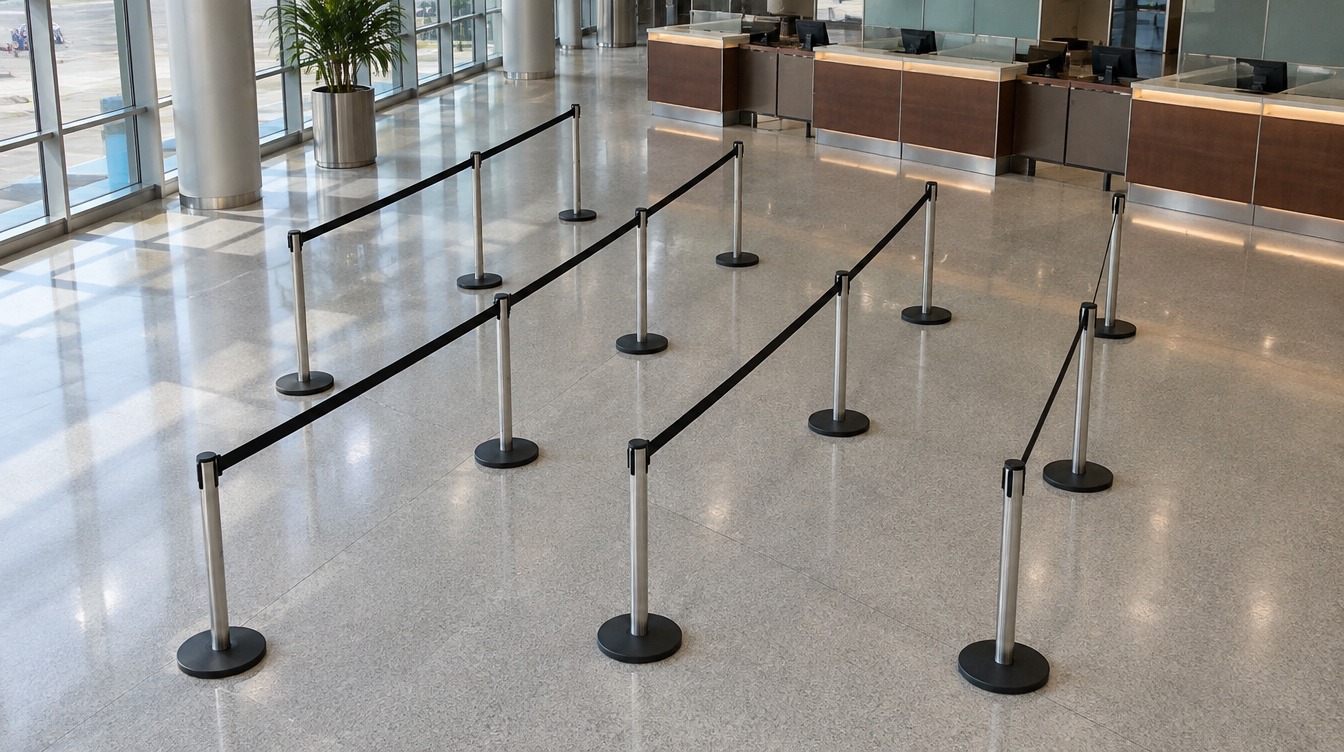
These counts assume a single straight run at 6-foot spacing. If you do not have 125 feet of clear floor, a serpentine layout folds the same capacity into a much smaller footprint — see the layout section below.
The Calculation, Step by Step
Step 1: Map your runs
A run is any straight line of posts connected by belts. Every corner or direction change starts a new run. Walk the actual space with a tape measure and mark the floor with tape if it helps. Do not measure around corners — treat each turn as a separate run.
Step 2: Calculate posts per run
For each run: (run length ÷ 6), rounded up, plus 1
- 24-foot run: (24 ÷ 6 = 4) + 1 = 5 posts
- 17-foot run: (17 ÷ 6 = 2.83, round up to 3) + 1 = 4 posts
- 40-foot run: (40 ÷ 6 = 6.67, round up to 7) + 1 = 8 posts
Step 3: Subtract shared posts
Add up the posts for all runs, then count how many times two runs meet at a corner or intersection. Subtract that number from your total. A single post serves both runs at each junction.
Example: An L-shaped queue with a 24-foot run and an 18-foot run. That is 5 posts + 4 posts = 9, minus 1 shared corner post = 8 posts total.
Step 4: Add entry and exit posts
Add one or two posts with sign holders at the head of the queue and at the entrance. These are not part of the belt run — they tell customers where the line starts and where to go next. Skipping them is the most common reason a well-built queue still confuses people.
How Many Posts by Layout Type
| Layout | Best For | Typical Post Count | Notes |
|---|---|---|---|
| Straight line | Ticket counters, reception desks | 4-8 | Simplest to set up and store |
| L-shape | Coffee shops, small retail, concessions | 6-10 | Fits a queue along two walls |
| U-shape | Event entrances, box offices | 8-14 | Two shared corner posts |
| Serpentine (3 lanes) | Airports, banks, high-volume retail | 12-18 | Maximum capacity per square foot |
| Serpentine (5 lanes) | Theme parks, stadium entries | 20-30 | Plan 3.5-4 ft between parallel lanes |
Belt Length Changes the Math — and the Price
Longer belts mean wider spacing, which means fewer posts for the same line. This is the single biggest lever on your total cost, and it is the one most buyers overlook.
| Belt Length | Working Spacing | Posts for a 60 ft Queue |
|---|---|---|
| 6.5 ft | 5-6 ft | 11-13 posts |
| 9 ft | 7.5-8 ft | 9 posts |
| 11 ft | 9.5-10 ft | 7 posts |
| 13 ft | 11.5-12 ft | 6 posts |
To compare quotes fairly, calculate the cost per foot of queue: divide the price of one stanchion by its belt length. An $80 stanchion with a 7-foot belt costs $11.43 per foot of queue. The same $80 stanchion with an 11-foot belt costs $7.27 per foot. Same unit price, 36 percent difference in what you actually pay to cover your space.
Fewer posts also means faster setup, less storage space, and fewer units to maintain or replace.
Do Not Forget ADA Requirements
If your queue serves the public, accessibility is not optional. Three things to plan for:
- Lane width: minimum 36 inches clear, measured from the center of each post base
- Turn areas: allow a 48-inch turning radius wherever the lane changes direction
- Belt detectability: single-belt stanchions are not detectable by a cane user. Dual-belt models with a lower belt meet accessibility guidance for visually impaired visitors
For government facilities, healthcare, and public venues, dual-belt stanchions are often specified for this reason. Factor that into your count and budget before you order.
Five Mistakes That Wreck the Count
- Measuring the belt instead of the floor. Spacing is measured center to center between post bases, not belt end to belt end. Bases are typically 13 to 14 inches across.
- Forgetting the last post. A run always has a post at both ends. The “+1” in the formula is not optional.
- Double-counting corners. Every intersection shares one post between two runs.
- Buying for average traffic, not peak. Size the line for your busiest hour, not your typical hour.
- No signage posts. A perfect layout with no “Line Starts Here” sign still produces confused customers.
When More Stanchions Is Not the Answer
If your line keeps growing no matter how many posts you add, the problem is throughput, not layout. A queue that is physically well organized but still 20 minutes long damages the customer experience just as much as a disorganized one.
That is the point where an electronic queue management system earns its cost. Our sister brand Qbuster Technologies directs waiting customers to the next available register using numbered displays, which cuts perceived wait time and reduces the staffing needed to manage the line. Stanchions organize the line; Qbuster moves it faster.
Get the Right Count for Your Space
Stanchions.com stocks retractable belt stanchions from 6.5 ft to 13 ft belt lengths, dual-belt ADA models, post-and-rope systems, and outdoor-rated barriers — in stock and ready to ship within 48 hours from our US warehouse. We have planned queue layouts for Fortune 500 retailers, stadiums, universities, and government facilities for over 20 years.
Not sure how many you need? Send us your floor dimensions and peak traffic and our team will spec the layout for you.
Read our stanchion spacing guide →
Browse stanchions by belt length → or see real installations in our Project Gallery →