
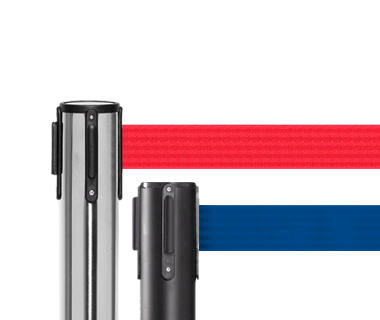
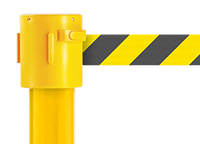

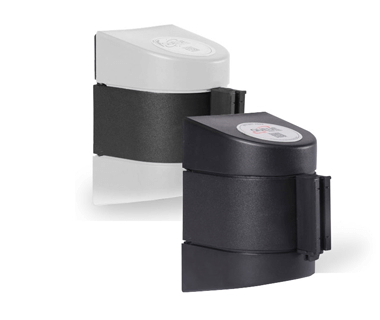

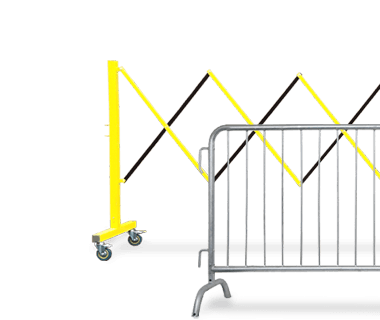


Quick answer: Choose retractable belt stanchions for queue lines, high-traffic areas, layouts that change, and anywhere outdoors. Choose post-and-rope stanchions for hotel lobbies, theaters, museums, and events where appearance matters more than flexibility. If your queue serves the public, the more important decision is single versus dual belt — standard single-belt and single-rope stanchions do not meet ADA detectability guidance.
Side-by-Side Comparison
| Factor | Retractable Belt | Post-and-Rope |
|---|---|---|
| Span per unit | 6.5 to 13 ft | 4 to 6 ft typical |
| Posts for a 60 ft queue | 6 to 11 | 11 to 16 |
| Setup time | Fastest — pull and clip | Slower — hang each rope |
| Layout changes | Adjusts instantly | Fixed rope lengths |
| Storage | Belt retracts into post | Ropes stored separately |
| Outdoor use | Weather-rated models available | Indoor only in practice |
| Appearance | Utilitarian, modern | Formal, premium |
| Branding | Printed belts, post-top signs | Rope color, post finish |
| Separate parts to buy | None — belt is built in | Ropes sold separately |
The Factor Most Buyers Miss: ADA Detectability
This is the decision point that matters most for public-facing queues, and it cuts across both product types.
A standard retractable belt and a classic velvet rope both sit at roughly waist height. Neither is detectable by a person using a white cane, because a cane sweeps at floor level and passes straight underneath. A visually impaired visitor can walk into the barrier without warning.
The fix is a second, lower line:
- Dual-belt stanchions add a lower belt within cane-sweep range
- Double-rope posts achieve the same with a second rope hung lower on the post
If you are specifying stanchions for a government office, courthouse, hospital, airport, university, or any public accommodation, plan on dual-line configurations from the start. Retrofitting after an accessibility complaint costs far more than specifying it correctly up front.
Lane width matters too: maintain a minimum 36 inches of clear width, measured center to center between post bases, with a 48-inch turning radius wherever the lane changes direction.
What to Look for in a Retractable Belt Mechanism
Not all retractable belts are built the same, and the differences are safety issues rather than preferences. A retractable belt is wound on a high-tension spring. Two features separate a professional-grade unit from a cheap one:
- Belt brake. Without a braking mechanism, a released belt snaps back into the cassette at speed. That is an injury risk at eye level for a child and a reliability problem for the cassette. A quality stanchion retracts the belt slowly and under control.
- Locking belt end. The belt end should lock into the receiving post rather than simply resting in a slot. This prevents accidental release when someone brushes the line, and discourages customers from unclipping the belt themselves.
These two features are the single clearest difference between a stanchion that lasts a decade in a high-traffic lobby and one that fails within a season. When comparing quotes, ask specifically about both.
Total Cost Over Five Years
Unit price is only part of the picture. The two types accumulate cost differently.
| Cost Driver | Retractable Belt | Post-and-Rope |
|---|---|---|
| Posts needed for same span | Fewer — longer reach per unit | More — shorter rope lengths |
| Connector cost | Included in the post | Separate purchase per span |
| Replacement parts | Belt cassette if spring fails | Ropes — soiling, fraying, loss |
| Cleaning | Wipe down | Velvet requires specialty cleaning |
| Setup labor | Minutes for a full line | Longer, especially for large layouts |
| Storage footprint | Compact — belts retract | Posts plus separate rope storage |
Ropes are the hidden line item. They are a separate SKU, they go missing at events, and velvet shows every mark in a high-traffic entrance. Budget for replacement ropes if you choose post-and-rope for anything busier than a quiet lobby.
On the belt side, the comparison that actually matters is cost per foot of queue: divide the stanchion price by its belt length. A longer belt covers more line per post, which lowers both the unit count and the total.
Which One for Your Venue
| Venue | Recommended | Why |
|---|---|---|
| Retail checkout | Retractable belt | Reconfigures as traffic shifts; branded belts |
| Airport, transit | Retractable belt, dual-belt | Long spans, heavy traffic, ADA requirement |
| Bank, government office | Retractable belt, dual-belt | Public accommodation; daily reconfiguration |
| Hotel lobby, ballroom | Post-and-rope | Appearance is part of the guest experience |
| Theater, museum | Post-and-rope | Formal tone; mostly static layouts |
| Red carpet, VIP area | Post-and-rope | The rope itself signals exclusivity |
| Stadium, arena | Retractable belt | Fast deployment, long runs, durability |
| Outdoor events | Retractable belt, weighted base | Weather-rated options; ropes sag and stain |
| Construction, worksite | Safety-rated belt stanchion | High-visibility; check OSHA requirements |
Many Venues Should Use Both
The choice is not always either-or. A well-planned space often uses each type where it does its job best:
- Retractable belts carry the main queue, where flexibility and throughput matter
- Post-and-rope marks VIP entrances, reserved sections, or the front-of-house area guests see first
A hotel might run post-and-rope at the lobby entrance and retractable belts at the back-of-house check-in overflow. A theater might use rope at the main doors and belts for the box office line. Matching the barrier to what each area is doing produces a better result than standardizing on one type everywhere.
Questions to Answer Before You Order
- Does this queue serve the public? If yes, specify dual-line for accessibility.
- Will the layout change week to week, or stay fixed? Changing layouts favor belts.
- Is any part of it outdoors? Ropes are impractical outdoors; choose weather-rated belts with weighted bases.
- How visible is this area to customers on arrival? Front-of-house appearance may justify rope.
- Who sets it up, and how often? Daily setup by one person favors retractable belts.
- Does the belt have a brake and a locking end? Ask before you buy.
Still Not Sure?
Stanchions.com carries both — retractable belt stanchions from 6.5 ft to 13 ft, dual-belt ADA configurations, and classic post-and-rope systems in a range of finishes. Everything is in stock and ships within 48 hours from our US warehouse. We have specified queue layouts for Fortune 500 retailers, stadiums, universities, and government facilities for over 20 years, and we are happy to tell you when the cheaper option is the right one.
Send us your space and we will spec it.
Calculate how many stanchions you need →
Read our stanchion spacing guide →
Browse stanchions by type → or see real installations in our Project Gallery →