



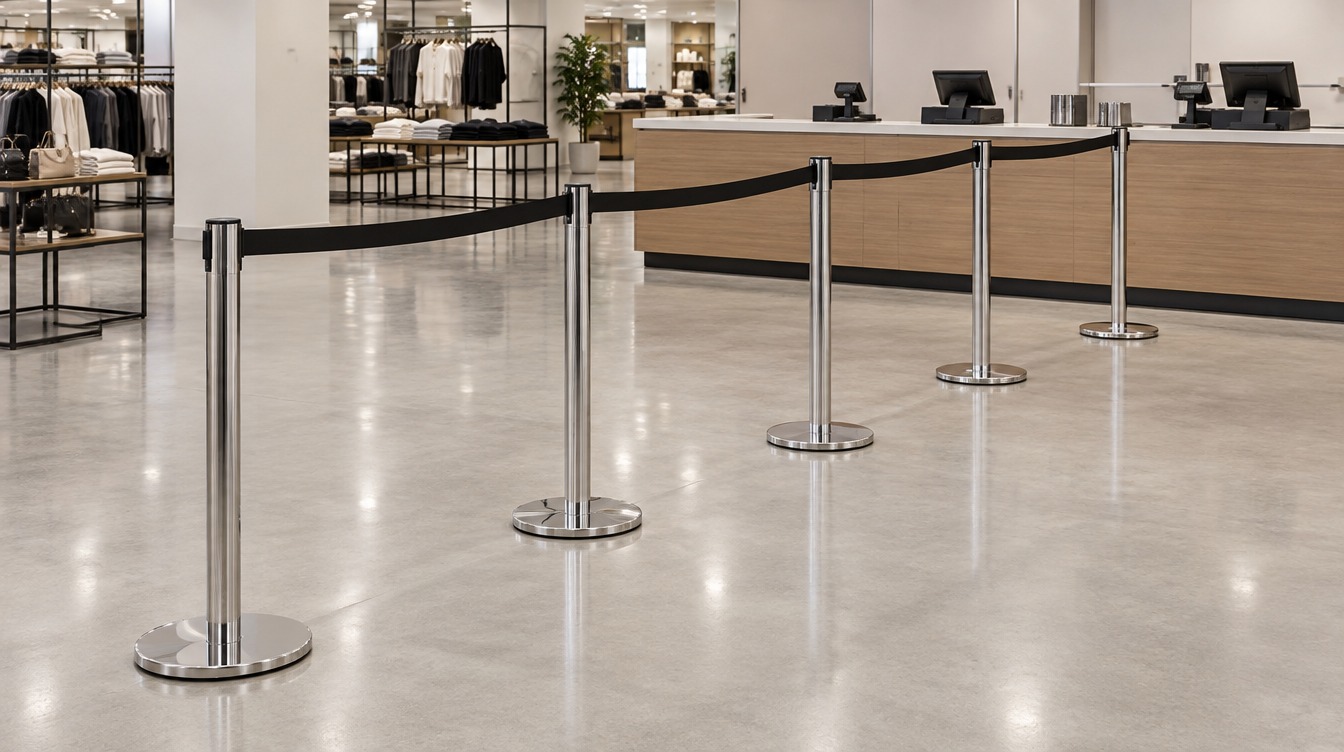
Quick answer: Stanchions should be spaced so the belt or rope is never fully extended — leave 12 to 18 inches of slack. For a standard 6.5-foot retractable belt, place posts about 5 to 6 feet apart. For a 10-foot belt, space posts 8.5 to 9 feet apart. This prevents tipping when the belt is pushed and keeps your queue line stable.
The Short Answer: 6 Feet Is the Industry Standard
If you want one number to work with, use 6 feet between posts. Most crowd control suppliers treat 6 feet as the standard center-to-center spacing for queue lines, and many stanchions are sold pre-configured for it. Common ranges you will see quoted:
| Situation | Recommended Spacing | Why |
|---|---|---|
| Standard queue line | 6 ft | Industry default; works with most belt lengths |
| General foot traffic flow | 6-8 ft | Keeps traffic moving without crowding |
| High-density crowds | 5-6 ft | Stops people stepping over or between belts |
| Wide spans, fewer posts | 8-9 ft | Requires 10 ft or longer belts |
| Absolute maximum | 6 ft (center to center) | Beyond this, belts sag and lines lose definition |
The belt-length method below gives you a more precise answer for your exact equipment, but 6 feet is a safe starting point for planning.
The Stanchion Spacing Formula
To calculate how many stanchions you need for any straight run:
- Number of posts = (Run length in feet ÷ 6), rounded up, then add 1
- Spacing between posts = Run length ÷ (number of posts − 1)
Worked Examples
| Queue Length | Posts Needed | Spacing |
|---|---|---|
| 12 feet | 3 posts | 6 ft apart |
| 17 feet | 4 posts | ~5.6 ft apart |
| 24 feet | 5 posts | 6 ft apart |
| 36 feet | 7 posts | 6 ft apart |
| 50 feet | 10 posts | ~5.5 ft apart |
Why You Should Never Fully Extend the Belt
A retractable belt at full extension has zero give. When a customer leans on it or a cart bumps it, the tension transfers directly to the posts — and even weighted bases can tip. Leaving 12–18 inches of belt inside the housing provides shock absorption and keeps the line intact during heavy traffic.
Spacing Rules by Stanchion Type
Retractable Belt Stanchions
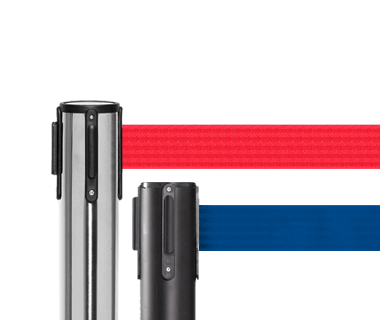
Most common for retail checkouts and airports. Standard belts are 6.5 ft, 10 ft, or 13 ft. Space posts at belt length minus 12–18 inches. Longer belts mean fewer posts, faster setup, and less storage space.
Post-and-Rope Stanchions
Used in hotels, theaters, and premium venues. Classic velvet ropes are 5 ft or 6 ft — space posts so the rope has a gentle, even drape (about 6–12 inches of visual sag). A rope pulled taut looks wrong and stresses the hooks.
Outdoor and Safety Applications
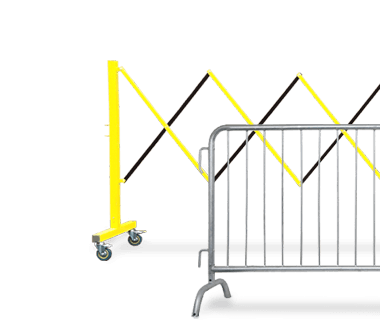
For safety barriers around hazards or restricted areas, use long-belt stanchions (10–13 ft) in straight runs. Fewer posts means faster deployment. Choose weighted, weather-resistant bases for outdoor use.
How Wide Should the Queue Lane Be?
Queue lanes should be at least 36 inches (3 feet) wide to accommodate wheelchairs and meet ADA accessibility guidelines — but not so wide that customers can pass each other and break the line order. For carts or strollers, 42–48 inches works better.
Three ADA-related dimensions to plan around:
- Minimum lane width: 36 inches (3 ft) clear width for wheelchair access
- Turn areas: allow a 48-inch turning radius wherever the lane changes direction
- Entrance and exit aisles: 48 inches or wider is recommended for smooth flow at both ends of the queue
Measure from the center of each post base, not from the belt. Stanchion bases are typically 13-14 inches in diameter, so a lane that measures 36 inches belt-to-belt may be narrower than 36 inches at floor level.
Planning a Full Queue Layout
- Keep the layout simple: one clear entrance, one clear exit
- Mark the entry with signage (“Line Starts Here”)
- Add a sign at the head of the queue (“Wait Here for Next Register”)
- For serpentine (back-and-forth) queues, allow 3.5–4 ft between parallel lanes
- Count shared corner posts once when totaling posts for L-shaped or serpentine runs
OSHA Spacing Rules for Safety and Construction Stanchions
Quick answer: For guardrail systems, OSHA requires stanchions no more than 8 feet apart. For control lines, the line must be flagged at intervals of no more than 6 feet. These rules apply to construction and industrial safety applications, not retail queue lines.
If you are specifying stanchions for a job site, warehouse, or any OSHA-regulated environment, the spacing requirements are stricter than retail crowd control:
| Requirement | OSHA Standard | Specification |
|---|---|---|
| Guardrail stanchion spacing | 1926.502(b), Appendix B | Maximum 8 ft apart |
| Control line flagging interval | 1926.502(g)(3)(i) | Every 6 ft or less, high-visibility material |
| Control line height | 1926.502(g)(3)(ii) | Lowest point 39 in. min, highest point 45 in. max |
| Control line breaking strength | 1926.502(g)(3)(iii) | Minimum 200 lbs |
| Warning line breaking strength | 1926.502(f)(2) | Minimum 500 lbs tensile |
Standard retail crowd control stanchions are not rated for OSHA guardrail or fall protection use. If your application involves fall protection, roof work, or a controlled access zone, you need equipment rated to the specification above — not a decorative post-and-rope system.
Shop Stanchions That Fit Your Space
Stanchions.com carries retractable belt stanchions with 6.5 ft to 13 ft belts, post-and-rope systems, and outdoor-rated crowd control barriers — in stock and ready to ship within 48 hours from our US warehouse. We’ve supplied queue solutions to Fortune 500 retailers, stadiums, universities, and government facilities for over 20 years.
Browse our stanchion collection → or see our work in the Project Gallery →